We spoke with one of the most awaited Japanese bands in Colombia and Latin America from Japan, whose cumbia tunes, World Music, and Caribbean rhythms and melodies are merged with the vision and folk lyrics inspired by the Nippon fishermen and miners: Minyo Crusaders, who will perform in the «Road Primavera Sound Bogotá» on December 9th at Movistar Arena. Spanish version.
Pedro Suarez.
Photo cover: Yukitaka Amemiya.
Photos: Pedro Suárez & Fuji Rock Fest Press Staff.
Japanese-Spanish Translator: Taiga Tanimura.
Japanese-English Translator: Tomoko Davies-Tanaka, Little Big/Onigiri Media.
Art pieces & MVs: under authorization by Fuji Rock Japan, Minyo Crusaders & Little Big for journalistic purposes.
Our first time in Japan included not only knowledge, revivals, and newbie experiences in this great ancient and imperial country. In addition, various festivals (matsuri) in summer have given us a pleasant experience. We saw how locals (and foreigners) got rid of our worries to just have fun and enjoy the season.
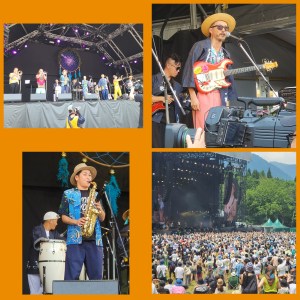
One of these festivals that we attended for the first time was the Fuji Rock Festival (FRF), an event that has been taking place for more than 25 years in the mountains of Naeba, Niigata Prefecture, as an integral part of summer musical activities both in the Kanto Region as in all the islands that make up the Nation of the Rising Sun. We will talk about this famous international festival later in another chronicle about our visit to Japan for the first time.
Foto: FRF Press Staff.
One of the bands and artists playing in one of the stage complexes in FRF, the Field of Heaven, was Minyo Crusaders. But how did the cumbia of Mt. Fuji emerge?
The year was 2011. Japan suffered the earthquake and tsunami aftermath, which we sadly have known as a worldwide tragedy. Katsumi Tanaka, leader and founder of the band, took an unexpected twist in his life: “Following the Tohoku earthquake of 2011, I reflected on my life, work, and identity. A world music fan, I began searching for Japanese roots music I could identify with. Discovering mid-late 20th century acts Hibari Misora, Chiemi Eri, and the Tokyo Cuban Boys, I was captivated by their eccentric arrangements and how they mixed min’yō with Latin and jazz (…); it was a revelation!”
What is the real meaning of 民謡 (min’yō)? “Originally, the min’yō are historic Japanese folk songs sung hundreds of years ago by working-class Japanese people such as fishermen, coal miners, and sumo wrestlers. [Unfortunately] these min’yō songs are now forgotten in Japan. [Therefore,] yet we want to make them popular again. We sing (min’yō) with Latin, African, Caribbean, and Asian rhythms, » Tanaka and the band stated.
Since then, Tanaka and lead vocalist Freddie held jam sessions to recruit several musicians at Banana House, a former military residence on the closed Yokota US Air Base, west of Tokyo, in Fussa. This is how Minyo Crusaders was born, and thanks to the support of their record label P-Vine Records, they managed to debut in 2017 with their album “Echoes of Japan,” whose success led them to unstoppable presentations of their renewed folkloric sound both at the recent Fuji Rock Festival and on other international stages in his own country, Europe and North America to this day.
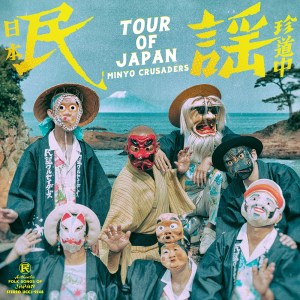
To end this current year, Minyo Crusaders will once again be visiting the cradle of cumbia this Saturday, December 9th, at the Movistar Arena in the Colombian capital, sharing the stage with Frente Cumbiero in a performance called Minyo Cumbiero. Before this long-awaited concert for the Primavera Sound Bogota, the band will initially release for Japan this November 24th its new album, “Tour of Japan”, with its single “Soran Bushi”, which will be available on Spotify. The international launch of this new album is scheduled for early 2024, so we will have to wait to see this emblematic song from the new album on their official YouTube channel.
In the middle of the Fuji Rock, and being the only official Latin American media there, we spoke with Tanaka this summer in which, for the first time, he had told us not only about this show in Colombia but also his personal and musical experience with Mario Galeano (Frente Cumbiero), as well as his respect and admiration for both Colombian and Latin American culture, in which he feels very close to us.
Bunka Wave.Thank you very much for accepting this interview for the Latin American followers. My first question is how you could reach out all about the Latin rhythms mixing up in your current music.
Katsumi Tanaka. I (Katsumi Tanaka) was a lover of world popular/folk music, collecting records and playing guitar. Tokyo has a lot of different types of hip music scenes. There are several small bars, clubs, and record shops that introduced me to different kinds of world music. With friends I met at these places, I formed a band that played Latin, Afro, calypso, and other tropical music, and we started to play at club events organized by friends.
Then came the Great East Japan Earthquake of 2011. This disaster and the Fukushima nuclear accident made me look over the country I live in, Japan, and myself. I began to think about my identity and how I could commit myself to society. This is where I came across Japanese folk songs. Japanese folk music is folk music that is firmly rooted in us Japanese. However, it hasn’t evolved in the way that world popular music my friends and I enjoy, such as Latin, Afro, and Caribbean music, has. It has been pushed into being part of the «musical training» or «only enjoyed during festivals for a limited time» rules.
I remembered that my musician friend Freddie Tsukamoto, who used to sing JAZZ and SOUL in the same city, actually sang folk songs as well, and I contacted him and said, «Let’s make some music that will really free the Japanese people’s minds». I imagined a scene of people dancing and singing without hesitation along with hip new folk songs in small clubs on street corners on weekends.
I played the melody of «Kushimoto Bushi» on the guitar to the cumbia beat. To my surprise, it was the same melody as the cumbia. It was when I realized that the world’s popular music and Japanese folk music, which I had always loved, had the same feeling. Then, I gathered my music friends from the same town and started Freddy Tsukamoto and the Minyo Crusaders.
B.W. How did you meet Mario Galeano (El Frente Cumbiero from Colombia), and describe your experience and memories working with him?
K.T. In 2018, the Minyo Crusaders performed at Fuji Rock, and El Frente Cumbiambero was also in Japan to perform at the same event. We loved their music and Mario’s project ONDATROPICA so much that we barged in backstage and said, ‘We are playing CUMBIERO in Japan, and we’re big fans of yours!’ ‘ and we became friends. Then, to our surprise, we received an offer to perform at the Colombia al Parque Festival in Colombia through their introduction. Colombia was a sacred place for us, so we thought it was the top of the mountain in the world. We never thought it would be the first place we would visit outside Japan. We even started a collaborative project with Mario and his friends to compose music, which was like a dream for us. I was surprised that coming to terms with one’s identity could lead to many different things, and I was grateful for Japanese folk music.
I also felt sympathy for Mario and his group’s approach to music and the way they dealt with their community. I thought that they embodied exactly the direction I felt I was heading in after the 2011 earthquake and tsunami.
B.W. Do you have considered exploring and composing more music with other Latin rhythms different from the Colombian cumbia in a future album?
K.T. We already have songs such as salsa-infused and merengue-inspired songs. We have performed these songs at our shows, but they have not been released yet.
B.W. What do you want to know about the culture and music in Latin America on a deeper level?
K.T. The more I listen to music from Colombia and the surrounding area, the more I realize that there are many different styles and a diverse mix of people and their cultures. I am interested in the historical and geographical background. It is the same with Japanese folk music; knowing how it has been transformed from its origins helps me understand many things.
B.W. What was the feedback or the answer from your fans in both cultures (Asian and Latin) about your music and songs?
K.T. We have not yet been to Asia outside Japan, so I don’t know the direct response, but musicians have emerged in South Korea and elsewhere who are using the same approach to update folk songs for the modern age. I have also been surprised by the very supportive messages I have received from people in Latin America on social networking sites since the video of ‘Cumbia delmonte Fuji’ produced with Frente Cumbiero was released. We were really happy to see so many audiences dancing to the salsa step on our European tours and other events!
B.W. Thank you again for your time in this interview with Bunka Wave. I’d like you to greet our Latin and Colombian followers, inviting them to listen to you.
K.T. It was a real blessing for us to encounter the powerful beats and emotional melodies of cumbia and find something in common with Japanese folk music. It would be great if you could find something in Japanese folk music like we found in cumbia.
Finally, check their kind greeting which the band announces their official feature on the Road to Primavera Bogota:




Un comentario en “From the Mt. Fuji to Monserrate, the Minyo Crusaders’ cumbia will sound in Colombia again”